
September Newsletter AI Scams Focus
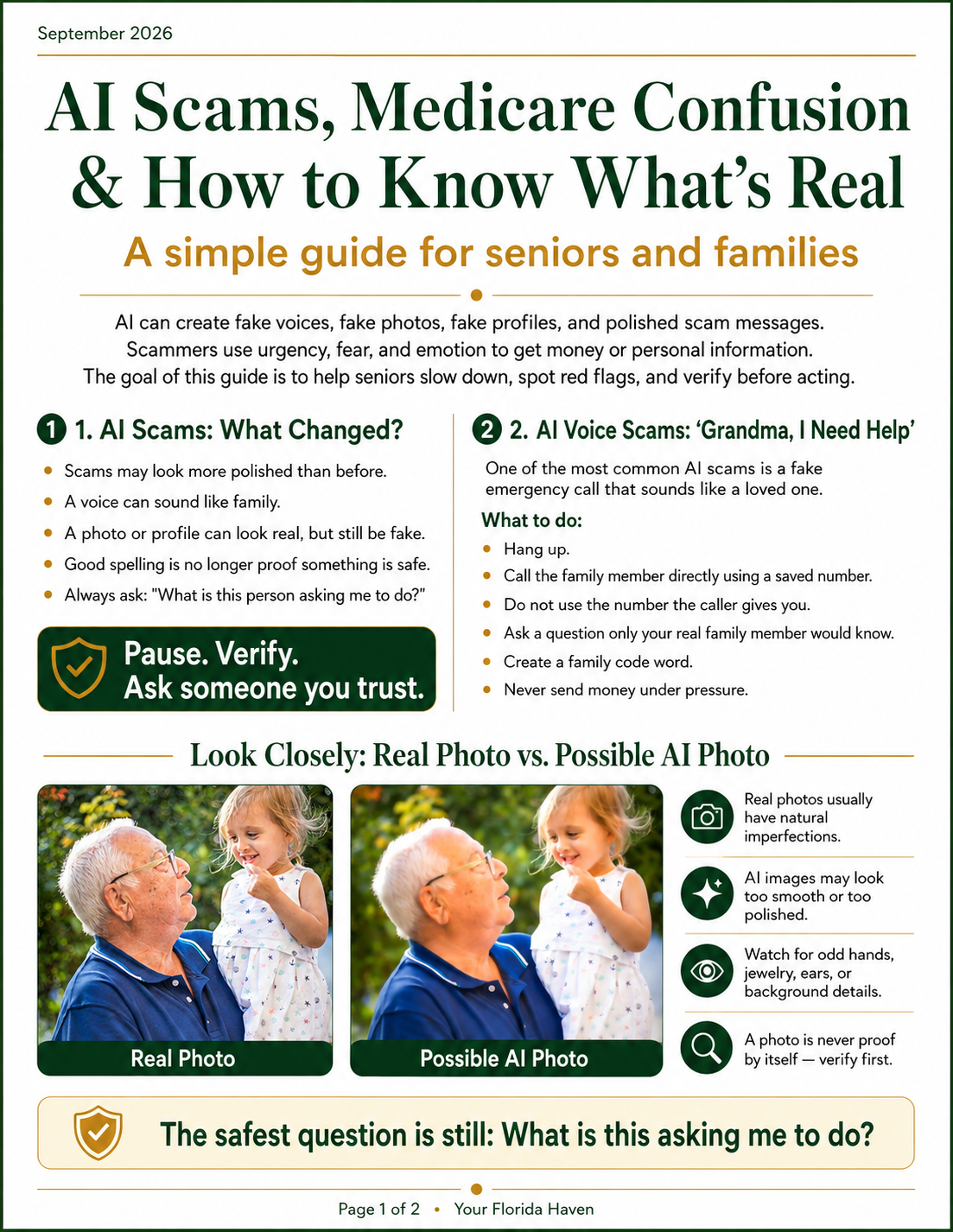
AI Scams, Medicare Confusion & How to Know What’s Real
A simple guide for seniors and families
Scams are changing fast.
For years, many people were told to watch for obvious spelling mistakes, strange emails, or suspicious phone numbers. That advice still matters, but it is no longer enough.
Artificial intelligence, often called AI, can now help scammers create fake voices, fake photos, fake videos, fake profiles, and polished messages that look and sound more believable.
A scam may not look sloppy anymore.
A voice may sound like someone you love.
A photo may look real.
A message may look official.
A Medicare ad may seem trustworthy.
That does not mean we should be afraid of everything. It means we need to slow down, verify, and ask better questions before we click, call, share, pay, or give out personal information.
The safest question is still:
What is this person asking me to do?
If someone is asking for money, passwords, Medicare numbers, Social Security numbers, gift cards, cryptocurrency, a one-time code, personal information, or secrecy, stop and verify first.
1. AI Scams: What Changed?
AI can make scams look more polished than before.
It can help scammers:
Write professional-looking emails
Create fake photos
Build fake social media profiles
Imitate a loved one’s voice
Create fake videos
Make fake ads or “official-looking” messages
Sound more personal and believable
That means the old warning signs may not always be obvious.
Good spelling does not mean something is safe.
A nice photo does not mean a person is real.
A familiar-sounding voice does not always mean the call is legitimate.
Mike’s rule:
AI may make a scam look better, but it cannot remove the red flags. Urgency, secrecy, pressure, money, and personal information are still the warning signs.
2. AI Voice Scams: “Grandma, I Need Help”
One of the most upsetting AI scams is the fake family emergency call.
A senior may receive a call that sounds like a grandchild, child, niece, nephew, or loved one. The voice may sound scared, panicked, or emotional.
The caller may say:
“I was in an accident.”
“I got arrested.”
“I am in trouble.”
“Please do not tell Mom or Dad.”
“I need money right now.”
Then another person may get on the phone pretending to be a lawyer, police officer, doctor, or bail bondsman.
This scam works because it targets love and fear.
What to do:
Hang up.
Call the family member directly using the number already saved in your phone.
Do not use the number the caller gives you.
Ask a question only your real family member would know.
Create a family code word.
Tell another family member before sending money.
Never keep it secret.
Mike’s reminder:
If someone says, “Do not tell anyone,” that is usually exactly when you should tell someone.
FTC information on AI voice cloning and family emergency scams:
3. Family Code Word Tip
Every family should have a simple emergency code word.
Do not use something easy to find online, like:
A pet’s name
A birthday
A school name
A street name
A grandchild’s name
A favorite sports team
Pick something random and memorable.
Examples:
Blue mailbox
Pancake Tuesday
Red umbrella
Garden turtle
If someone calls claiming to be family and asks for money, ask for the code word.
If they do not know it, hang up and verify.
This one small step can stop a very emotional scam.
4. Real Photo vs. Possible AI Photo
AI can create photos of people who do not exist. It can also make real photos look slightly altered, polished, or too perfect.
That means a scammer can create a fake profile with a friendly face, family-looking photos, and a believable story.
A photo alone is not proof that someone is real.
Real-life photo clues may include:
Natural lighting
Normal background
Small imperfections
Consistent details
Real-life setting
Possible AI photo clues may include:
Skin that looks too smooth
A face that looks too perfect
Strange hands or fingers
Uneven eyes or ears
Odd jewelry
Blurry or unrealistic background
Distorted text
Details that do not make sense
But remember: AI images are getting better.
Do not rely on one clue alone.
The safest question is still:
What is this person asking me to do?
If the answer involves money, secrecy, urgency, investing, personal information, or moving the conversation off-platform, slow down and verify.
5. Fake Profiles and Social Media Traps
AI can help scammers create fake online identities.
This is common in:
Romance scams
Friendship scams
Fake veteran profiles
Fake widower or widow profiles
Fake investment profiles
Fake business pages
Fake customer support pages
Fake Medicare benefit ads
Watch for these warning signs:
The profile looks new.
The photos look too polished.
The person avoids meeting in person.
They quickly want to move the conversation to text, WhatsApp, Messenger, or email.
They ask for money, gift cards, cryptocurrency, or help with an emergency.
They talk about investing.
They ask you not to tell your family.
Mike’s rule:
If an online relationship turns into a money request, stop. Real friendship does not require secrecy, pressure, or payments.
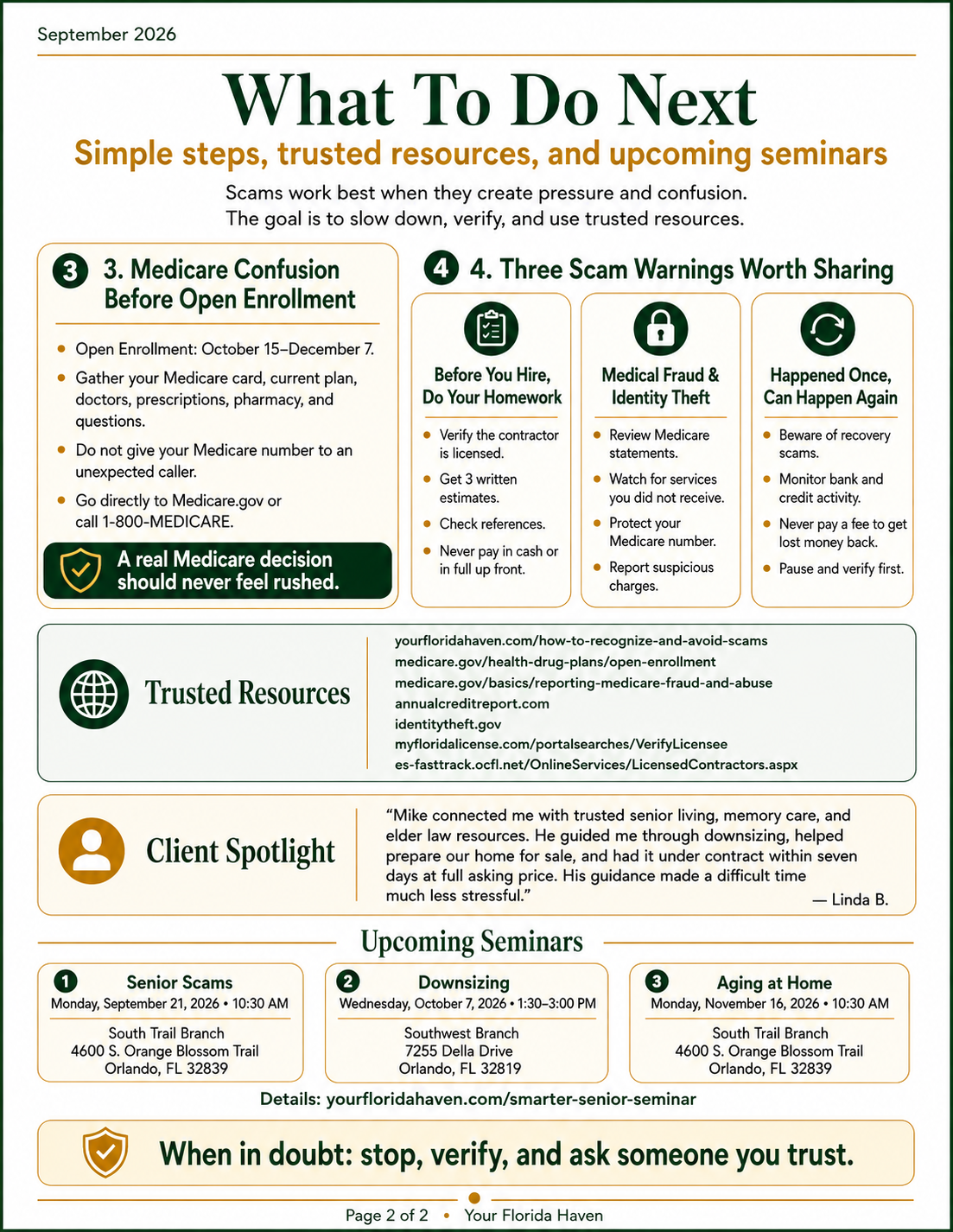
6. Medicare Confusion Before Open Enrollment
Medicare Open Enrollment runs from October 15 through December 7 each year.
This is the time when people with Medicare can review and make changes to their health or drug coverage for the following year.
That also means seniors may start seeing more:
Medicare mailers
Plan advertisements
Phone calls
TV commercials
Social media ads
“Free benefit” offers
Medicare Advantage plan comparisons
Messages that sound official
Some may be real.
Some may be confusing.
Some may be misleading.
Some may be scams.
Before making changes, gather:
Your Medicare card
Your current plan information
A list of your doctors
A list of prescriptions and dosages
Your preferred pharmacy
Any letters from your plan
A list of questions
A legitimate Medicare decision should not feel rushed. It should be based on your doctors, medications, budget, coverage needs, and personal situation — not pressure from a phone call or ad.
Official Medicare Open Enrollment information:
https://www.medicare.gov/health-drug-plans/open-enrollment
7. Medicare + AI Scam Warning
AI can make fake Medicare messages look more professional.
A scammer may say:
“Your Medicare card is expired.”
“You qualify for a free benefit.”
“You must verify your Medicare number.”
“Your plan will be canceled.”
“You are missing out on money.”
“Click here to compare benefits.”
“Act before Open Enrollment ends.”
Red flags:
They ask for your Medicare number.
They ask for your Social Security number.
They pressure you to act today.
They ask you to click a suspicious link.
They offer something “free” but want personal information.
They say your coverage will stop unless you respond.
What to do:
Do not give your Medicare number to an unexpected caller.
Do not click suspicious Medicare links.
Go directly to Medicare.gov.
Call 1-800-MEDICARE if needed.
Ask a trusted person before making changes.
Medicare fraud and abuse reporting:
https://www.medicare.gov/basics/reporting-medicare-fraud-and-abuse
8. Contractor Scam Warning: Before You Hire, Do Your Homework
Planning a home repair, renovation, roof project, or storm-related repair?
Do not let a scammer turn your next project into a costly mistake.
Home repair scams often target seniors because the pressure can feel immediate. Someone may knock on the door after a storm, say they noticed damage, claim they have leftover materials, or offer a “today only” deal.
Before hiring a contractor:
Verify the contractor is properly licensed.
Get at least three written estimates.
Ask for references — and actually check them.
Read the contract carefully before signing.
Never pay in cash.
Never pay in full before the work is completed.
Do not sign anything at the door under pressure.
Be especially cautious of anyone who:
Shows up at your door offering repairs
Claims they have “leftover materials”
Pressures you to decide immediately
Demands a large upfront payment
Only accepts cash
Says a written contract is not necessary
Mike’s note:
A legitimate contractor will not be offended if you ask questions, check references, verify licensing, or take time to review the estimate.
Florida DBPR License Search:
https://www.myfloridalicense.com/portalsearches/VerifyLicensee
Orange County Licensed Contractor Lookup:
https://es-fasttrack.ocfl.net/OnlineServices/LicensedContractors.aspx
Source: R.O.S.E. Resources
9. Medical Fraud and Identity Theft
Medical fraud can be easy to miss because it may not start with money coming directly out of your pocket.
It may show up as a fraudulent medical charge, fake claim, or service listed on your Medicare or insurance account that you never received.
Why it is dangerous:
Fraudulent charges can become part of your medical record. That can create problems with future diagnoses, treatments, coverage, or insurance claims.
Red flags include:
Unexpected calls asking for your Medicare number or insurance information
Someone calling to “verify benefits”
Offers for free medical equipment
Claims for services you did not receive
Bills from providers you do not recognize
Medical supplies arriving that you did not order
How to protect yourself:
Review your Medicare Summary Notice or Explanation of Benefits.
Report suspicious charges.
Hang up and verify through the company’s official contact methods.
Do not share your Medicare number or insurance information with unexpected callers.
Do not accept “free” medical equipment from someone who contacts you out of the blue.
Mike’s note:
Treat your Medicare number like a credit card. If someone contacts you unexpectedly and asks for it, stop and verify first.
Medicare fraud and abuse reporting:
https://www.medicare.gov/basics/reporting-medicare-fraud-and-abuse
Source: R.O.S.E. Resources
10. Happened Once, Can Happen Again
If you have experienced identity theft or fraud before, do not let your guard down.
Many people believe that once they have recovered from a scam, the danger is over. Unfortunately, scammers may target previous victims again — sometimes months or even years later.
They may even pretend they can help recover lost money.
This is called a recovery scam.
A recovery scam may sound like:
“We can get your money back.”
“We found the person who scammed you.”
“We can recover your cryptocurrency.”
“You only need to pay a small fee first.”
“We need access to your computer or account to help.”
This week’s safety tip:
Be cautious of anyone claiming they can recover lost money for a fee.
Continue monitoring your bank accounts and credit reports.
Never share personal or financial information after unexpected calls, emails, or texts.
If something feels off, pause, verify, and talk to someone you trust.
Do not feel embarrassed. Scammers are professionals, and they are persistent.
You can check your credit reports at the official site:
https://www.annualcreditreport.com
Identity theft recovery help:
Source: R.O.S.E. Resources
11. AI Scam Safety Checklist
Before trusting a call, photo, video, message, ad, contractor, or Medicare offer, ask:
Was I expecting this?
Is this asking for money?
Is this asking for my Medicare number, Social Security number, password, or code?
Is this asking me to click a link?
Is this trying to scare me?
Is this asking me to keep a secret?
Is this asking me to act right now?
Can I verify it through an official website or phone number?
Would I feel comfortable showing this to a trusted family member or Mike?
If the answer makes you uneasy, stop.
Do not click.
Do not send money.
Do not share information.
Verify first.
12. Trusted Resources
Your Florida Haven Scam Safety Guide:
https://yourfloridahaven.com/how-to-recognize-and-avoid-scams
Medicare Open Enrollment:
https://www.medicare.gov/health-drug-plans/open-enrollment
Medicare Fraud Reporting:
https://www.medicare.gov/basics/reporting-medicare-fraud-and-abuse
Annual Credit Report:
https://www.annualcreditreport.com
Identity Theft Help:
Florida DBPR License Search:
https://www.myfloridalicense.com/portalsearches/VerifyLicensee
Orange County Licensed Contractor Lookup:
https://es-fasttrack.ocfl.net/OnlineServices/LicensedContractors.aspx
FTC AI Voice Scam Warning:
13. Client Spotlight
“Mike connected me with trusted senior living, memory care, and elder law resources when my husband’s needs became too much to manage alone. He guided me through downsizing, helped prepare our home for sale, and had it under contract within seven days at full asking price. His guidance made a difficult time much less stressful.”
— Linda B.
14. Upcoming In-Person Seminars
September Seminar: Senior Scams
Seniors Kick Back: Smarter Senior Seminar Series – Scams
Monday, September 21, 2026
10:30 AM
South Trail Branch
4600 S. Orange Blossom Trail
Orlando, FL 32839
Learn about scams targeting seniors. Bring a spouse, friend, adult child, caregiver, or neighbor. Scams are easier to avoid when families talk about them together.
Seminar details:
https://yourfloridahaven.com/smarter-senior-seminar
October Seminar: Downsizing
Smarter Senior Seminar Series: Downsizing
Wednesday, October 7, 2026
1:30 PM - 3:00 PM
Southwest Branch
7255 Della Drive
Orlando, FL 32819
Aging brings new decisions, and downsizing does not have to feel overwhelming. Learn simple steps to begin decluttering, decide what to keep, donate, sell, or pass down, and reduce stress during the downsizing process.
Seminar details:
https://yourfloridahaven.com/smarter-senior-seminar
November Seminar: Aging at Home
Seniors Kick Back: Smarter Senior Seminar Series – Aging at Home
Monday, November 16, 2026
10:30 AM
South Trail Branch
4600 S. Orange Blossom Trail
Orlando, FL 32839
Most seniors want to stay in their home as long as possible. This seminar will help seniors and families understand what support, services, and planning may be needed to age in place safely.
Topics include home health care, companionship, doctor appointment support, pet support, light housekeeping, preparing your home as you age, trusted maintenance resources, caregiver and guardian management, decluttering, and organization.
Seminar details:
https://yourfloridahaven.com/smarter-senior-seminar
Final Reminder
Scammers work best when they create pressure and confusion.
Your best defense is simple:
Pause. Verify. Ask someone you trust.
Mike Flahaven
Your Florida Haven / Senior Haven Consulting
407-340-5291